
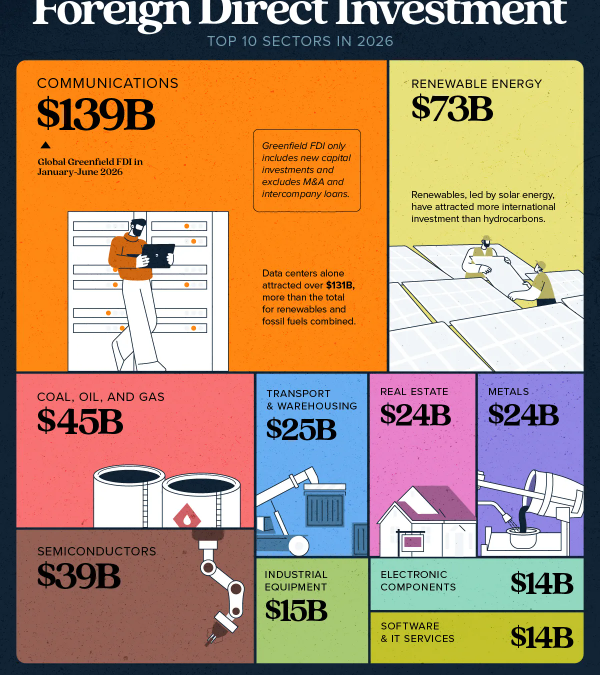
A look at the sectors pulling in the most foreign investment right now
According to new data from fDi Intelligence, reported by Visual Capitalist, global investors announced roughly $538 billion in cross-border greenfield investment in the first half of 2026 alone. Greenfield investment means money going into brand new projects and facilities built from the ground up, not acquisitions of existing businesses, and not internal loans between related companies. It’s capital that creates new capacity, new construction, and new jobs in the country receiving it.
One sector is pulling away from everything else
Communications came out on top by a wide margin, attracting $139.3 billion in the first half of the year, nearly as much as the next three sectors combined. And it’s not spread evenly across the sector. More than 94% of that communications investment, over $131 billion, went specifically into data centers.
The reason is straightforward: artificial intelligence needs enormous computing power to train and run, and that computing power lives in physical buildings full of servers. Nearly a quarter of all the money pledged to data centers globally came from a single transaction: in May 2026, SoftBank committed more than $50 billion to build data center capacity in France, expected to deliver 3.1 gigawatts of capacity starting in 2031. It would reportedly be the largest investment of its kind in Europe’s history.
Key note:
- Communications is the top sector for global foreign direct investment, attracting $139 billion thus far in 2026.
- Data centers accounted for more than 94% of communications investment.
- Renewable energy attracted $73 billion, roughly $29 billion more than coal, oil, and gas.
The ripple effect is already showing up elsewhere in the ranking
Renewable energy came in second at $73.3 billion, and coal, oil, and gas came in third at $44.7 billion, both driven substantially by the same underlying force: data centers need enormous, reliable amounts of electricity, and that demand is pulling investment into power generation right alongside the computing infrastructure itself. Notably, roughly three-quarters of the fossil fuel investment total came from a single new natural gas plant being built in Ohio specifically to serve a nearby data center.
Semiconductors rounded out the top four at $38.8 billion, though that’s a noticeable pullback from the $138 billion invested across the whole of 2025. Transportation and warehousing, real estate, metals, industrial equipment, electronic components, and software and IT services filled out the rest of the top ten, each connected in some way to the broader AI infrastructure build-out.
Why this matters
When this much global capital concentrates this quickly into one theme, it changes the environment for both investors and businesses, whether that is the cost and availability of electricity, the priorities of banks and institutional lenders, or which sectors attract talent and government incentives over the next several years.
For investors, it is worth considering how these capital flows are reshaping valuations, opportunities, and risks across industries, and whether the sectors receiving the most attention today will continue to benefit as investment accelerates. For business owners, the same shifts can influence access to capital, input costs, competitive dynamics, and the opportunities available to their industry.
Whether you are investing in the infrastructure behind these trends, operating a business positioned to benefit from them, or simply watching capital move away from other sectors as it chases AI, this kind of data is a useful gut check on where the broader economic tailwinds and headwinds are actually pointed.
Image Source: fDi Intelligence, via Visual Capitalist