

For decades, investors relied on a simple rule: hold stocks for growth and bonds for stability. While this approach worked for many years, it no longer provides the protection it once did. Recent research shows that traditional fixed income is no longer the diversification anchor it used to be, and relying solely on stocks and bonds leaves portfolios vulnerable to market shocks.
Historically, bonds were expected to move opposite equities, cushioning portfolios when markets fell. However, since 2020, things have drastically changed and ‘diversification has become harder since 2020 as stocks and bonds tend to move in tandem during sharp selloffs, adding to financial stability concerns’.
As illustrated in the chart below, bonds shown in blue and equities shown in red historically moved in opposite directions, so when stocks declined, bonds provided protection. Today, however, they tend to move together, which reduces that diversification benefit.
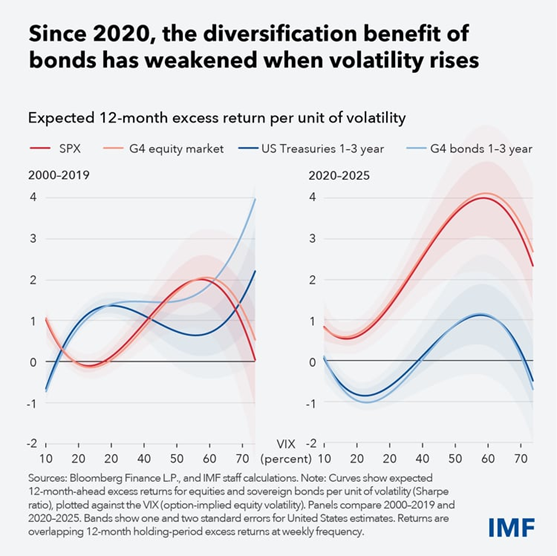
This change matters for investors because the traditional role of bonds as a safety net is no longer guaranteed. When stocks and bonds move together, portfolios can face losses on multiple fronts at once. Major institutions are encouraging a broader view of diversification:
- The International Monetary Fund highlights that during market selloffs, stocks and bonds increasingly move together, meaning both can decline at the same time (IMF, 2026).
- BlackRock warns that traditional bonds now provide less reliable protection due to rising correlations, inflationary pressures, and global monetary shifts (MarketWatch, 2026).
- J.P. Morgan notes that persistent inflation risks and elevated stock–bond correlations are prompting a rethink of the classic 60/40 portfolio in favor of strategies that include diversification beyond traditional stocks and bonds. (60/40 reinvention, JP Morgan)
With traditional bonds no longer providing reliable downside protection, modern portfolios require multi-dimensional strategies:
- Global Diversification: Spreading investments across regions reduces reliance on any single bond or equity market, helping mitigate simultaneous declines in domestic bonds and stocks.
- Alternative Fixed-Income Solutions: Inflation-protected bonds, short-duration strategies, and other non-traditional income assets reduce sensitivity to rising interest rates while still generating income.
- Real Assets as a Hedge: Investments in real estate, infrastructure, or commodities offer returns less correlated to equities and bonds, providing a buffer when traditional fixed income fails.
- Low-Correlation and Hedge Strategies: Investments designed to reduce portfolio risk or smooth returns when stocks and bonds move together. Examples include market-neutral funds, long/short equity strategies, or tactical hedging using derivatives. These strategies help stabilize performance when traditional assets are under pressure.
- Private Market Exposure: Select private equity or credit opportunities offer return streams and risk profiles that often behave differently than public markets, adding diversification beyond traditional bonds.
- Active Risk Management: Stress-testing portfolios, adjusting allocations, and monitoring correlations ensures these strategies remain effective against evolving market conditions.
Key Points for Investors:
- True diversification preserves wealth, not just checks boxes. Relying on a traditional 60/40 equity-to-bonds mix reflects outdated assumptions rather than rigorous risk analysis.
- Global events can impact both stocks and bonds simultaneously; traditional bonds may not provide the safety investors expect.
- Expanding diversification across geographies, asset types, and low-correlation strategies is essential for building a resilient portfolio.
- Working with a financial planner helps ensure that your portfolio is stress-tested and aligned with your long-term goals.
True portfolio resilience requires a strategic, multi-dimensional approach that balances growth and risk. By broadening diversification beyond the traditional stock-and-bond mix, investors can pursue long-term goals while safeguarding wealth against the unexpected.
In a world where stocks and bonds can fall together, diversification is no longer just about what you own, it’s about how it behaves. Our approach blends global exposure, multiple asset types, and access to strategies most advisors can’t reach, giving portfolios the flexibility to navigate markets in ways a traditional allocation cannot.